The creative landscape of sound design is evolving rapidly, with artificial intelligence reshaping what’s possible in studios and home setups alike. Imagine crafting polished tracks faster than ever, whether you’re working in Mumbai or Chennai. Modern solutions now handle everything from generating basslines to balancing frequencies, giving artists more time to focus on their unique vision.
These innovations aren’t just for professionals. Aspiring creators across India can access studio-grade results without expensive equipment. Platforms analyze your recordings, suggest improvements, and even emulate classic studio effects. The result? A streamlined workflow that turns rough ideas into radio-ready tracks.
From automated vocal tuning to intelligent drum patterns, technology bridges the gap between technical skill and artistic expression. Producers now experiment with genre-blending sounds while maintaining crystal-clear mixes. This guide explores practical ways to harness these advancements, helping you create music that stands out in today’s competitive scene.
Key Takeaways
- AI-driven platforms simplify complex tasks like mixing and mastering
- Accessible solutions empower creators at all skill levels
- Automated features reduce time spent on technical adjustments
- Smart algorithms enhance creativity through unique sound suggestions
- Real-time feedback helps polish tracks to professional standards
Introduction to AI in Music Production
Modern sound creation has entered a new era where smart solutions amplify human creativity. While some creators worry about authenticity, these systems act as collaborators, not replacements. They help translate ideas into polished compositions faster than manual methods.
Evolution of AI in the Music Industry
Early algorithmic systems could only generate basic melodies. Today’s neural networks analyze thousands of tracks to suggest harmonies that match your style. They detect subtle patterns in rhythm and mood, adapting to genres from Bollywood pop to Carnatic fusion.
Why Producers Are Adopting Smart Technology
Precision and speed top the list of benefits. Instead of spending hours tweaking EQ settings, you get instant suggestions that preserve your artistic intent. Platforms now generate drum fills or vocal harmonies that feel surprisingly human.
Another advantage? Creative spark. Imagine software proposing a konnakol rhythm blended with electronic beats—ideas you might never try alone. These tools learn from global trends while respecting regional flavors, making them ideal for India’s diverse music scene.
How to Use AI Tools for Music Production and Mastering in 2024
The future of audio engineering has arrived, blending technical precision with creative exploration. Modern creators now leverage intelligent systems to refine their sound while preserving artistic identity. This shift empowers artists across India to achieve studio-quality results without years of technical training.
Understanding the Benefits of Artificial Intelligence
Smart algorithms transform tedious tasks into effortless processes. They analyze vocal takes, adjust instrument levels, and even propose melodic variations. This lets you focus on storytelling through sound rather than getting stuck in technical weeds.
Platforms learn from global music trends while respecting regional styles. A Chennai-based producer might receive suggestions blending mridangam rhythms with synth waves. These adaptive features help maintain cultural authenticity while pushing creative boundaries.
Key Advantages in Mixing and Mastering
Time-consuming processes like frequency balancing now take seconds. Systems compare your track against genre-specific references, applying EQ tweaks that enhance clarity. Workflow improvements are dramatic—what once required hours of trial-and-error happens in real time.
- Automatic detection of clashing frequencies
- Dynamic adjustment of stereo imaging
- Intelligent loudness optimization for streaming platforms
The final master retains your unique sonic fingerprint while meeting commercial loudness standards. Artists gain confidence knowing their music translates perfectly across devices—from smartphone speakers to festival sound systems.
Exploring AI-Powered Plugins for Creative Music Production
Creative boundaries in sound design are expanding as intelligent plugins become essential collaborators. These solutions spark fresh ideas while maintaining technical precision, letting artists focus on their vision rather than mechanical tasks.
Innovative Tools for Melody and Rhythm Generation
The Orb Producer Suite redefines composition with four specialized plugins. Orb Chords crafts harmonic foundations using its wavetable synth, while Orb Melody suggests lyrical phrases that adapt to your project’s key. Basslines gain depth through Orb Bass’s intelligent patterns, and Orb Arpeggio adds rhythmic complexity with its polyrhythm engine.
What sets this producer suite apart? Real-time synchronization ensures all elements—chords, melodies, bass—evolve cohesively. Block chaining lets you experiment with structure, building tracks that shift seamlessly between verse and chorus.
Highlights from Orb Producer Suite and Similar Plugins
Beyond the Orb Producer ecosystem, Google’s Magenta Studio offers five adaptive tools for Ableton Live. Its algorithms transform basic MIDI patterns into genre-defying progressions, perfect for blending Carnatic scales with electronic beats.
- Dynamic chord progression generator
- Beat variations influenced by global trends
- Context-aware melody suggestions
These tools act as creative accelerators, providing starting points that retain your artistic voice. Producers across Mumbai and Bengaluru now craft intricate arrangements faster, merging traditional instrumentation with futuristic textures.
Advanced AI Tools for Mixing and Mastering
The final polish on a track separates amateur drafts from professional releases. Cutting-edge solutions now handle intricate adjustments that once required seasoned engineers, empowering creators to achieve studio-quality results faster.
Automated Processing with Izotope and Sonible
Izotope Neutron 4’s Mix Assistant transforms raw recordings. It analyzes audio characteristics, applying EQ, compression, and stereo imaging tailored to your track. Bus processing becomes intuitive—adjustments feel natural rather than robotic.
Ozone 10 accelerates the mastering process with smart presets. The system suggests enhancements while preserving your mix’s essence. Sonible’s Pure Bundle simplifies dynamics control—its one-knob Compressor and Limiter adapt to any input signal instantly.
Streamlining the Mastering Workflow
These tools handle technical heavy lifting. Spectral analysis identifies clashing frequencies, while loudness optimization meets streaming standards. You retain full control over every parameter after initial processing.
The quality rivals manual engineering, particularly for newer producers. Focus shifts from technical hurdles to creative choices—vocal nuances, emotional textures, and cultural elements shine through. Mumbai-based artists report cutting mastering time by 60% while maintaining regional authenticity.
Innovative Vocal AI Tools Transforming Production
Vocal tracks now achieve studio-quality realism through cutting-edge synthesis. New platforms analyze human speech patterns to generate expressive singing voices, revolutionizing how producers craft hooks and harmonies. These solutions bridge language barriers while preserving regional musical identities.
Realistic Vocal Synths: Synthesizer V and Vocaloid 6
Dreamtonics Synthesizer V sets new standards for authenticity. Its neural networks capture breath control and vibrato, producing vocals indistinguishable from human performances. Solaria, their latest voice model, handles Hindi and Tamil lyrics with natural phrasing.
| Feature | Synthesizer V | Vocaloid 6 |
|---|---|---|
| Languages Supported | 12+ | 7 |
| Vocal Control | Dynamic expression sliders | Preset emotion profiles |
| Integration | AU, VST, Standalone | VST3, Standalone |
| Unique Feature | Real-time pitch correction | Vocalo Changer effect |
Yamaha’s Vocaloid 6 offers broader voice customization. The Vocalo Changer transforms recorded tracks into synthesized voices instantly—perfect for creating backup harmonies or experimental textures.
Voice Cloning and AI-Cover Platforms
Advanced models clone vocal timbres from short samples. Producers in Mumbai use this to generate demos with placeholder vocals before final recordings. Ethical guidelines ensure artists retain ownership of their voice prints.
These tools empower creators to experiment freely. Blend classical Indian singing styles with electronic beats, or craft multilingual tracks that resonate across borders—all while maintaining emotional authenticity.
AI Web Apps Enhancing Workflow and Collaboration
Breaking down songs into individual parts used to require studio magic. Now, web-based solutions deliver instant stem separation through your browser. Producers across India rediscover creative freedom by reshaping existing audio into fresh compositions.
Seamless Stem Separation with LALAL.AI and Moises AI
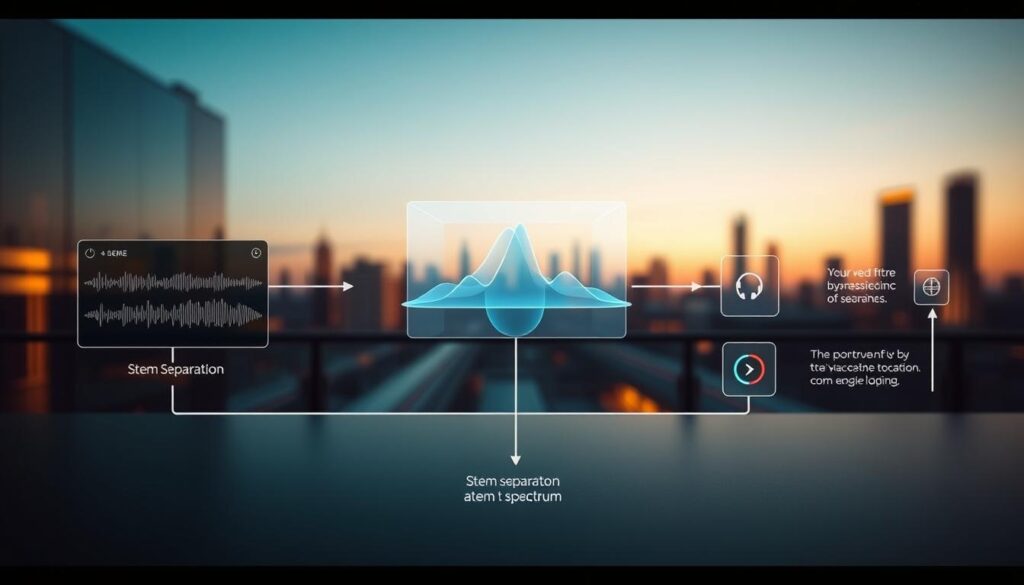
LALAL.AI splits full tracks into vocals, drums, bass, and instruments in seconds. Extract specific elements from Bollywood classics or indie demos for remixing. While results vary by source material, it’s perfect for sampling regional instruments or crafting acapella versions.
Moises AI offers similar capabilities with a focus on practice tools. Its separation engine shines on complex Carnatic recordings, isolating tanpura drones or mridangam rhythms. Both platforms eliminate costly software—just upload and download stems ready for your DAW.
- Browser-based processing works on any device
- Preserve cultural nuances in separated audio
- Experiment with mashups blending traditional and modern sounds
These tools transform collaboration. Share isolated stems with co-producers in Mumbai or Chennai via cloud links. Revive old recordings by extracting crisp vocals from noisy demos. What once took days now happens during chai breaks.
Integrating AI Tools with Traditional DAWs
Bridging the gap between innovative technology and classic workflows transforms modern music creation. Most producers already use DAWs like Ableton Live or Logic Pro—the challenge lies in weaving smart tools into these trusted environments. Compatibility ensures your creative process stays smooth while unlocking new possibilities.
Seamless Workflow Partnerships
Leading DAWs now support AI-powered software through VST/AU plugins. Ableton’s Max for Live platform hosts adaptive EQ tools that learn from your mixing habits. Logic Pro users benefit from smart mastering assistants that analyze reference tracks within the same project.
FL Studio’s Patcher system lets you chain neural networks alongside traditional effects. This flexibility matters for India’s diverse creators—imagine blending tabla samples with AI-generated synth pads in one session. Updates ensure new tools work across versions, so your workflow never breaks.
Key advantages emerge when DAWs and intelligent software collaborate. Real-time stem separation in Logic speeds up remix creation. Automated track labeling in Cubase saves hours during complex music projects. These integrations let Mumbai beatmakers and Chennai composers focus on what matters—their art.