Top 5 AI Music Distributors 2026
AI tools can help an artist sketch a chorus, test a sound, or build a full demo in minutes. Getting that music onto Apple Music, Spotify, and other services is a different task. A distributor must accept the content, deliver accurate metadata, and pay the right party.
This guide ranks five services for artists releasing AI-generated or AI-assisted music. It focuses on policy, price, royalties, ownership, delivery, payout terms, and release tools. Use the live terms linked on each service page before sending a track.
Top 5 AI Music Distributors 2026: Quick Answer
The best music distributor depends on how the song was made and how much control the artist wants. A fully AI-generated track may face stricter review than a song where a human wrote lyrics, arranged sections, performed vocals, or edited the final mix.
For this comparison, the working shortlist is DistroKid, TuneCore, CD Baby, LANDR, and UnitedMasters. These services differ in pricing, release tools, royalty handling, and artist support. Their policies can change during the year, so treat this ranking as a decision framework rather than a permanent approval list.
Start with the policy check
Before paying for distribution, confirm that your model, samples, lyrics, vocals, and final recording meet the current terms.
How the Five Distributors Were Ranked
A useful ranking must look beyond a low headline price. The right service is the one that can deliver the release, preserve the artist’s rights, report royalties clearly, and provide a workable process when a platform questions the content.
Policy fit
Can an artist submit AI-assisted or AI-generated music? Are disclosures, human contributions, or proof of rights required?
- AI policy clarity
- Rights and ownership terms
- Review and takedown risk
Commercial value
Does the price make sense for a single release, a growing catalog, or frequent uploads?
- Subscription or per-release price
- Royalty share
- Extra service fees
Release control
Can the artist manage metadata, credits, territories, dates, and future edits without unnecessary friction?
- Platform delivery
- Release management tools
- Reports and payouts

Comparison Table: Price, Royalties, and AI Policy
The table gives a fast comparison. Exact pricing and policy language should be checked on each distributor’s official page on the day of upload. Some services offer a free tier, while others charge per release or per year. A low price may still include limits on support, splits, withdrawals, or features.
| Distributor | Best fit | Pricing model | Royalty approach | AI policy question | Key tool |
| DistroKid | Frequent independent releases | Annual plan structure | Review current terms | Confirm accepted AI content and rights proof | Upload and catalog management |
| TuneCore | Artists wanting broad release services | Plan and release options may vary | Review current terms | Check disclosure and ownership rules | Release administration |
| CD Baby | Artists preferring one-time release payment | Per-release structure | Review current terms | Confirm eligibility before delivery | Single-release delivery |
| LANDR | Artists needing production tools | Plans and release options | Review current terms | Check music ownership and model restrictions | Mastering and release workflow |
| UnitedMasters | Artists seeking distribution and opportunities | Free tier and paid options may apply | Review current terms | Confirm policy for generated vocals and compositions | Artist services and distribution |
Important: Do not treat a distributor’s acceptance as proof that a song is copyrightable. Distribution, copyright, publicity rights, and platform eligibility are separate questions.
1. DistroKid: Best for Frequent Independent Releases
DistroKid is often considered by artists who plan to release many songs or tracks per year. Its annual plan approach can make sense when an artist has a steady schedule and wants one dashboard for delivery, metadata, and catalog administration.
For AI-assisted music, the key review is not only whether the service accepts the track. The artist should confirm that every sample, voice, lyric, melody, and model output may be used commercially. A generated vocal that imitates a recognizable person can create a separate rights problem.
Advantages
- Useful for artists planning frequent uploads
- Central catalog and release workflow
- Convenient option for recurring distribution needs
Disadvantages
- Annual costs require careful catalog planning
- Policy details must be checked before every upload
- Extra features may affect the final price
Check DistroKid’s current terms
Use the official service page to confirm price, AI-generated music rules, ownership requirements, and current platform delivery options.
2. TuneCore: Best for Broad Artist Services
TuneCore suits artists who want distribution supported by a wider set of artist services. It can be a practical choice for a developing artist or small label that needs more than a basic upload page.
Before selecting a plan, compare the cost of unlimited uploads with the cost of the number of releases you actually expect. Also review whether the royalty structure, payment threshold, and content review process fit your catalog.
Advantages
- Broad set of distribution and artist tools
- Suitable for artists building a professional catalog
- Can support structured release planning
Disadvantages
- Plan differences can make price comparison harder
- AI disclosure requirements may need close reading
- Some features may depend on eligibility or region
Compare TuneCore options
Review the current plan, royalty, payout, and AI content terms before choosing a subscription or release route.
3. CD Baby: Best for One-Time Release Payments
CD Baby is a strong comparison point for artists who prefer a per-release model instead of an annual subscription. This approach may suit an artist with a small catalog, occasional songs, or a release that is intended to remain available for many years.
Calculate the total cost before choosing this distributor. Include the release price, possible commission, optional services, payment processing, and any cost connected to collecting publishing royalties. The cheapest first payment is not always the lowest long-term price.
Advantages
- Per-release model can suit occasional releases
- Clear fit for artists avoiding recurring plans
- Useful comparison for long-term catalog decisions
Disadvantages
- Frequent uploads can increase total yearly cost
- Royalty and optional service terms need review
- AI-generated tracks may receive additional scrutiny
Review CD Baby before paying per release
Confirm the current release price, commission, payout terms, platform list, and rules for AI-assisted and fully AI-generated music.
4. LANDR: Best for Production and Distribution Tools
LANDR is relevant to artists who want production support near the distribution workflow. Mastering, file preparation, and release delivery can be useful when the artist is working alone and needs a practical set of tools.
Production convenience does not replace rights clearance. An artist must still confirm the license for each AI model, loop, sample, vocal, and sound effect. Keep project files that show the human creative work and the source terms used for the final track.
Advantages
- Combines production support with release tasks
- Useful for independent artists working without a team
- Encourages attention to audio quality before delivery
Disadvantages
- Bundled tools may cost more than basic distribution
- Artists should compare included features carefully
- AI model licenses remain the artist’s responsibility
Explore LANDR’s release workflow
Check which mastering, distribution, pricing, and AI content options are available for your location and catalog size.
5. UnitedMasters: Best for Artist Opportunities
UnitedMasters may appeal to artists who want distribution connected with broader artist opportunities. Its free tier can be useful for testing a release path, but artists should compare the limits, royalty terms, payment conditions, and available tools before relying on it for a full catalog.
Read the content policy with special care if a song uses generated vocals, a cloned voice, or a model trained on material supplied by another creator. A platform opportunity cannot remove the need for consent, licensing, and accurate credits.
Advantages
- Free tier may lower the entry barrier
- Can connect distribution with artist-facing services
- Useful for testing an early release strategy
Disadvantages
- Free and paid plans may have different terms
- Artists should check payout and ownership language
- Opportunity-based services may not fit every catalog
Check the UnitedMasters free tier
Confirm what the free tier includes, how royalties are handled, and whether your AI-assisted or AI-generated content is eligible.
AI Music Policy: What Artists Must Check
AI-generated music is not one legal or commercial category. A human-written song with an AI-assisted mix may receive different treatment from a track created almost entirely by a model. The distributor may ask about the model, the inputs, the artist’s contribution, and the rights attached to the output.
Fully AI-generated music
For a fully AI-generated song, document the model used, the date of creation, the prompt process, the applicable terms, and every human edit. Do not claim exclusive rights that the model provider does not grant. Avoid prompts or training inputs that use protected lyrics, melodies, or a person’s identity without permission.
AI-assisted music
For AI-assisted music, record the human contribution. Save lyrics, composition files, vocal takes, arrangement changes, MIDI edits, and mix decisions. These records do not guarantee copyright protection, but they can help explain how the final track was made.
Disclosure and metadata
Use accurate metadata. Credits should identify the actual writers, performers, producers, and rights holders. If a distributor or streaming service asks for AI disclosure, answer directly. Never hide generated vocals or synthetic performances to avoid a review.
Streaming Platform Delivery and Release Management
Distribution is more than sending an audio file. The distributor transfers audio, cover art, metadata, credits, release dates, territories, and identifiers to streaming services. An error in one field can delay a release or connect it to the wrong artist page.
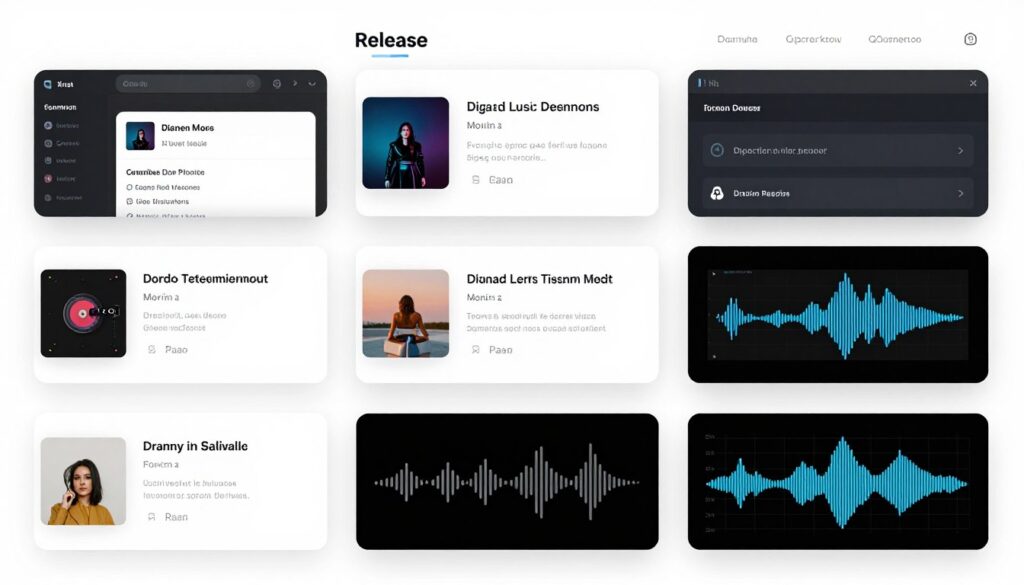
Check the delivery scope
- Supported streaming and download platforms
- Territory controls and takedown process
- Pre-save or scheduled release options
- ISRC and UPC handling
- Artist-page matching and corrections
Check the release tools
Useful tools include catalog editing, team access, split payments, label management, analytics, and automated reports. Artists should also ask how quickly a corrected track can be redelivered and whether a takedown removes every version of the release.
Pricing, Fees, Royalties, and Payout Terms
Compare the full cost of music distribution, not just the advertised price. A service may charge a subscription, a fee per release, a commission on royalties, or extra fees for optional tools. Some services offer a free tier, but a free upload can include limits or different commercial terms.

Single release
Compare the per-release price with the expected life of the song. Check whether the release stays online after one payment and whether later edits create a new fee.
- One-time price
- Commission
- Long-term availability
Catalog growth
For several songs per year, calculate the annual total. Include albums, singles, alternate versions, and collaborations.
- Tracks per year
- Plan limits
- Catalog tools
Royalty payout
Review payment timing, minimum withdrawal, supported payment methods, tax forms, and reporting delays.
- Payment threshold
- Reporting schedule
- Tax documentation
Simple calculation: estimate yearly cost by adding all plan, release, commission, payment, and optional tool charges. Then compare that figure with the number of tracks delivered per year.
Ownership, Copyright, and Licensing Risks
A distributor can deliver a song without giving the artist exclusive copyright in every element. Copyright rules may depend on human authorship, jurisdiction, the source material, and the model’s terms. The artist remains responsible for lawful content.
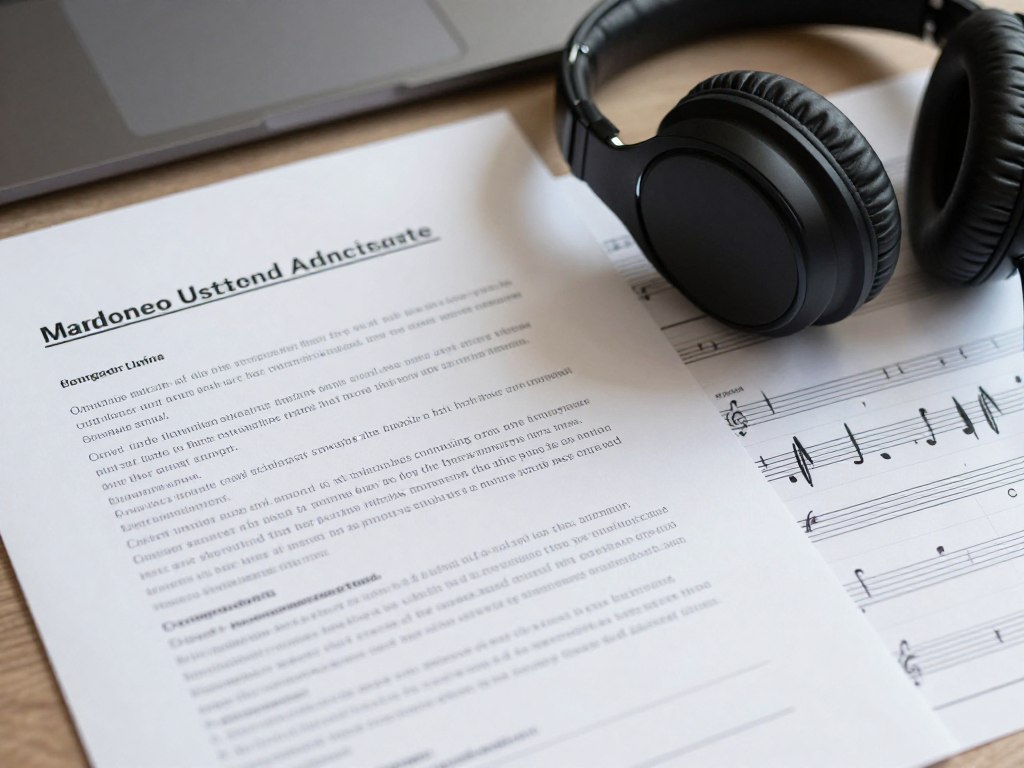
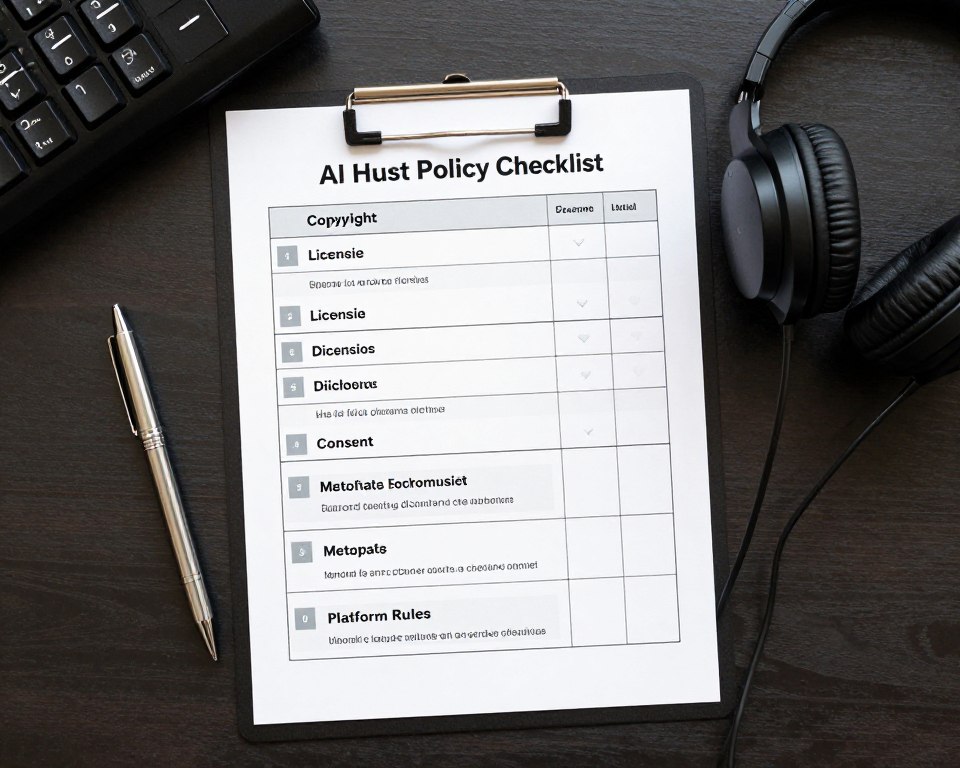
Keep a rights file
- Model name and version
- Model terms active when the track was made
- Prompts and source files
- Sample and loop licenses
- Consent for voice or likeness use
- Human-written lyrics and composition notes
- Final mix and master files
Do not use an AI model to recreate a living artist’s voice or style in a way that suggests endorsement. Do not upload a song containing uncleared samples. If a collaborator owns part of the track, put the split in writing before delivery.
Metadata and Upload Requirements for AI Tracks
Good metadata helps a distributor and streaming service understand the release. Use the correct artist name, song title, version, language, writers, producers, featured artists, and explicit-content status.
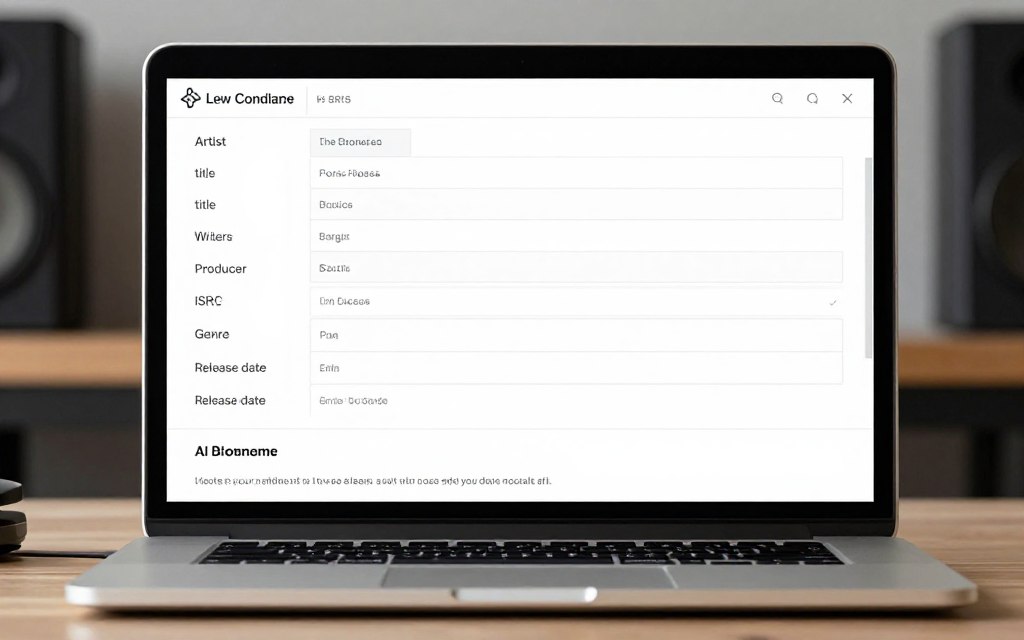
Before every upload
- Listen to the final track from start to finish.
- Check that the cover art is original and properly licensed.
- Confirm writer, performer, producer, and label credits.
- Review AI disclosure and vocal identity statements.
- Set the release date with enough delivery time.
- Save a copy of the submitted metadata.
Never add a famous artist as a featured performer unless that artist actually participated and approved the credit. Incorrect metadata can cause a takedown, a payment dispute, or an artist-page mismatch.
CTA Analysis of the Three Ranking Pages
The supplied ranking-page records contain no HTML body, CTA text, button markup, forms, or placement data. Exact CTA claims would therefore be unreliable. The analysis below identifies the likely search role of each page from its URL and title and gives the elements to verify during a live page review.
| Ranking page | Primary goal | Likely audience | Likely offer | CTA to verify |
| Once: best AI music distributors ranked 2026 | Inform and compare | B2C artists; cold to warm research visitors | Online distribution service | Product links, plan review, or registration button |
| Undetectr: best distributors for AI music ranked 2026 | Inform, with possible product lead generation | AI music creators concerned about acceptance and detection | Online service or related digital service | Native service link, trial, or subscription action |
| Soundverse: AI music distribution checklist 2026 | Inform and generate qualified leads | B2C creators and small teams preparing a release | Online music tool or checklist-style information offer | Checklist download, product trial, or registration |
What successful pages usually do well
Comparison pages commonly use native links after a product summary. This format fits search intent because the visitor is already evaluating options. Checklist pages often use a practical download or registration CTA because the reader has a task to complete.
The strongest tone is helpful rather than aggressive. A button that says “Check current AI terms” sets a clear expectation. A button that says “Get started now” is less useful when the visitor still needs to verify rights and pricing.
Best CTA Placement for This Comparison Article
One CTA is not enough for a long article, but too many buttons can reduce trust. Use a short sequence that follows the reader’s decision process.
Opening CTA
Place a soft checklist link after the quick answer. It serves visitors who need a safe next step without interrupting the answer.
- Low commitment
- Cold visitor friendly
- Anchored to compliance
Product CTAs
Place one button after each product section. The surrounding evidence should explain who the service suits and what the reader must verify.
- High relevance
- Clear product intent
- Easy comparison
Closing CTA
End with a decision action after the FAQ. Link to the selected distributor’s current terms or invite the reader to use a genuine release checklist.
- Hot visitor friendly
- Supports registration
- Does not overpromise
Which Music Distributor Fits Your Release Plan?
Select a service based on the catalog and the type of AI contribution, not on a headline badge. A new artist with one song has a different cost problem from a label preparing dozens of tracks per year.

Choose a frequent-upload service when
You expect many tracks per year, need repeated delivery, and value a central catalog dashboard. Calculate the annual price and confirm what happens if the plan ends.
Choose a per-release service when
You release occasionally and want to avoid a recurring payment. Check the long-term availability of the song, commission, and extra fees before deciding.
Choose a production-led service when
You need mastering, file preparation, and distribution in one workflow. Confirm that the included production tool supports the quality and file format required by your release.
Choose a free tier when
You are testing a release plan and accept possible feature limits. Read the free-tier royalty, payout, support, and ownership terms with the same care as a paid plan.
AI Music Distribution Workflow for a Safe Release
A repeatable workflow reduces errors. It also gives the artist evidence of the human decisions and rights checks behind each release.
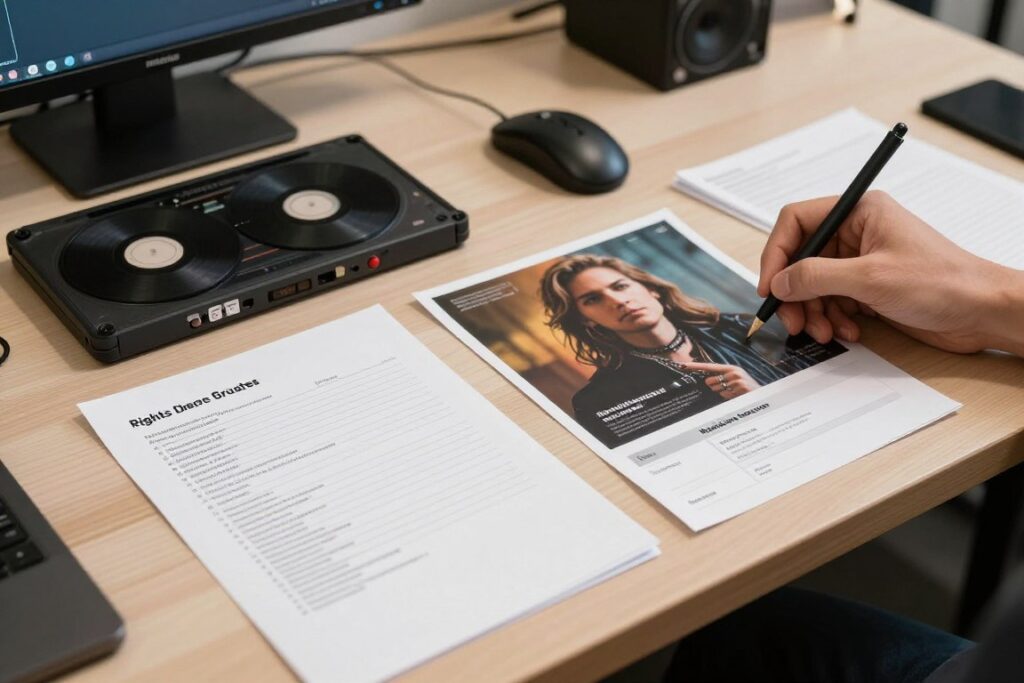
- Identify every AI model, sample, loop, voice, and external asset used in the song.
- Read the applicable commercial-use and ownership terms.
- Confirm that the lyrics, composition, recording, and artwork do not infringe another creator’s rights.
- Document the human contribution, including writing, performance, arrangement, editing, and mixing.
- Prepare clean audio, cover art, credits, identifiers, and release metadata.
- Check the chosen distributor’s current AI policy before paying or uploading.
- Submit the release early enough to allow platform review.
- Inspect the live listing and correct any metadata or artist-page error.
- Save royalty reports, invoices, licenses, and correspondence in the rights file.
Prepare your next release
Use this workflow before you choose a plan. It can reveal rights or metadata problems before they delay delivery.
Frequently Asked Questions About AI Music Distribution
Do all music distributors accept AI-generated tracks?
No. Policies differ, and a distributor may review fully AI-generated music more closely than AI-assisted music. Check the current terms before every upload.
Can I distribute a song made with an AI model?
Possibly, if the model license, distributor policy, platform rules, and rights in the inputs allow commercial distribution. Keep records of the model and the human work.
Is AI-assisted music copyrightable?
Copyright may protect original human expression, but the answer depends on the work and jurisdiction. Distribution acceptance does not decide copyright ownership.
Should I disclose AI use in metadata?
Disclose AI use when the distributor or platform requires it. Accurate credits and clear records are safer than trying to conceal generated vocals, lyrics, or composition.
Which price model is best for artists?
A per-release price may suit occasional songs. An annual plan may be better for frequent uploads. Compare the total cost, royalties, payout terms, and tools for your expected releases per year.
Can an AI-generated song use a cloned celebrity voice?
Do not use a person’s voice or likeness without appropriate consent and rights. A distributor or platform may reject the track, and legal exposure can remain even after delivery.
Final Recommendations for AI Musicians
The best music distributor is the one that matches your release pattern and rights position. DistroKid may suit frequent independent uploads. TuneCore may appeal to artists seeking a wider service set. CD Baby is worth comparing for occasional, per-release distribution. LANDR is useful when production tools matter. UnitedMasters may suit artists evaluating a free tier and broader opportunities.
Do not choose by price alone. Read the AI policy, confirm commercial rights, document human contribution, enter accurate metadata, and compare royalties and payout terms. Recheck the live policy before every release because model licenses, platform rules, and distributor policies can change during the year.
Choose with evidence, then release
Compare the five services against your catalog size, AI workflow, budget, ownership records, and desired platforms. Use the official terms before registering or paying.